
Escape Room Cards
Design
Building
Testing
Research
Documenation
Overview
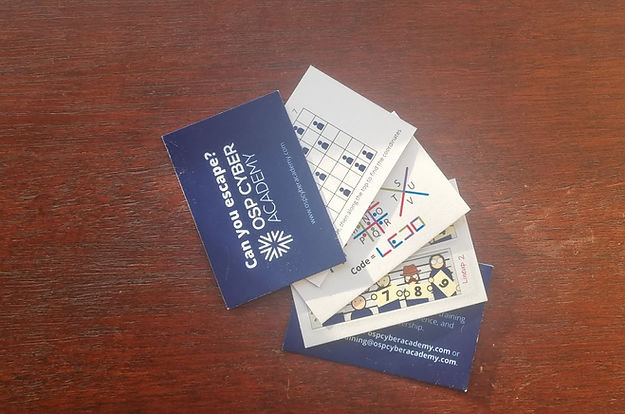
This project involved making sets of cards, each card with a different puzzle on it that needs to be solved in order to reveal a code, which reveals the conclusion to the cards scenario. This is supposed to simulate an escape room on the micro level.
Originally intended to advertise the business, showing off how OSP Cyber Academy can educate about cyber topics in an engaging and entertaining way, this has now evolved to cover more topics and age groups.
Process
As the originator of this project I have been very involved. I came up with the initial idea, pitched it and came up with the framework to make subsequent cards easier and faster to produce. I also created the majority of the scenarios and puzzles across the cards, or adapted the few I didn’t so they would work properly.
I then worked with colleagues to ensure the cards made sense to others, and iterated on the design until they worked, were easy to understand, appealing and sent the message we wanted them to.
The Framework
The framework
The format the cards take needs to be quick to pick up, with minor set up and no mess created. As such, they need needed to fit a few requirements:
-
Completable in a short time
-
Cheap to make
-
Engaging
-
Educational
As such, the card games need to work with minimal pieces, and only paper pieces, with no other equipment so they can be printed and played, and so they do not make a mess when they are run.
Most of these cards are designed to be bought as a pack that an educator would buy, then run themselves, they must also be:
-
Able to be run by someone without expert knowledge on the subject matter
-
Useful in an educational setting
With this in mind, each set of cards comes with additional notes, covering both the answers to the puzzles and notes on what each puzzle can be used to discuss.
Animation
I’ll go through the course, section by section, animating the videos in Vyond. This starts with blocking the animations, then filling in detail and matching the animations to the audio, getting feedback throughout. The goal is to create animations that are memorable and tell a story, in addition to being educational.
Puzzle Creation
Each set of cards has multiple puzzles. The first step to creating these puzzles is always checking the target audience, their age and their knowledge level. This can include researching the knowledge the audience is supposed to know and the knowledge they probably already have. This determines the puzzle difficulty and subject matter.
There can then be a mixture of research into different types of puzzles, and creation of original ones. By now there is a library of pre-used puzzles as well, so not every set of cards need entirely new puzzles, but can reuse old puzzles in a new format and context, and can include increasing or decreasing the difficulty.
At this point in development the puzzles tend to be in a less than polished state, made for proof of concept more than looking good, and only after testing and approval do I go back in and make them look good, creating all the visuals, either from scratch or from re-use of other assets in the cards. Then they go through a round of tidying.
These puzzles are tested throughout, first on colleagues, which tends to lead to the largest changes in legibility and clarity, but occasionally lead to a complete change of direction. They are then tested on the target audience, which tends to be more about difficulty. After this the cards themselves are then ready for distribution.
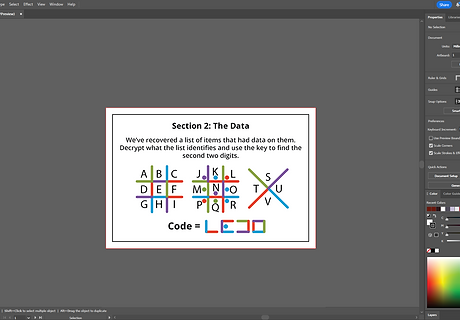
Puzzle created in Adobe Illustrator. This in particular is an example of a Pigpen cypher, which is used to translate the words, the player will then do the calculation using the list and corresponding images. This connects to ideas around passwords and encryption.
Documentation
the full package isn't complete without the additional documentation. These behind the scenes documents make sure whoever is running the card games can both provide answers to the player and educate about the themes of the cards. As such, the decks also come with an Answer Key, fully illustrated with examples, along with a talking points document, explaining exactly what each card can be used to discuss and how to take the education further.
This is all written and presented in an easy to understand and enguaging way.